A modern firewall and up-to-date antivirus software are no longer enough to protect an organisation. Most incidents happen elsewhere: an access right that was never revoked, a backup that was never tested, or an employee who clicks on the wrong link.
In Switzerland, the Federal Office for Cyber Security (FOCS) received 27,128 voluntary reports of cyber incidents during the first half of 2026 alone, in addition to 200 mandatory reports from operators of critical infrastructures. Attackers are now using artificial intelligence to personalise their attacks. In response to this changing threat landscape, security needs to be approached as a coherent whole, rather than as a collection of separate tools.
This is precisely what an Information Security Management System, or ISMS, is designed to achieve. We will look at what it covers, what it brings in practical terms, and how to implement it, even with limited resources.
ISMS: what exactly are we talking about?
An ISMS is a structured set of rules, processes, responsibilities and technical measures that enables an organisation to manage information security on an ongoing basis.
The key word is “management”. An ISMS is neither a piece of software nor a one-off audit. It is a way of managing security, just as an organisation manages quality or finances, by setting objectives and planning regular reviews.
The international reference is the ISO/IEC 27001 standard. It sets out the requirements for an ISMS in clauses 4 to 10 and, in Annex A, provides 93 security controls divided into four categories: organisational, people, physical and technological.
What are the three security objectives of an ISMS?
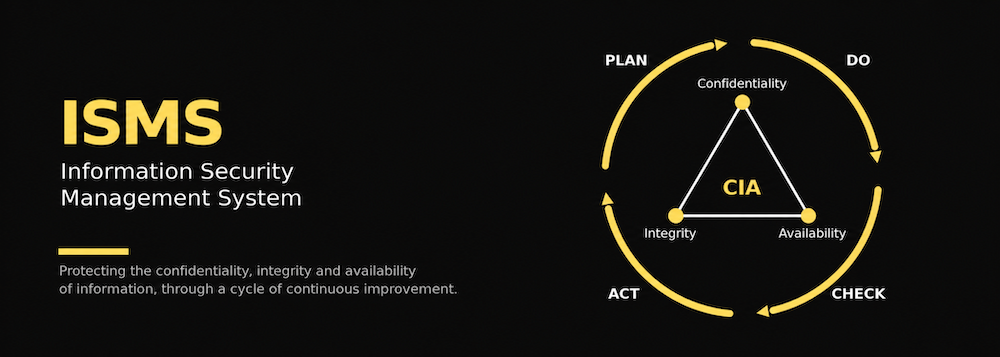
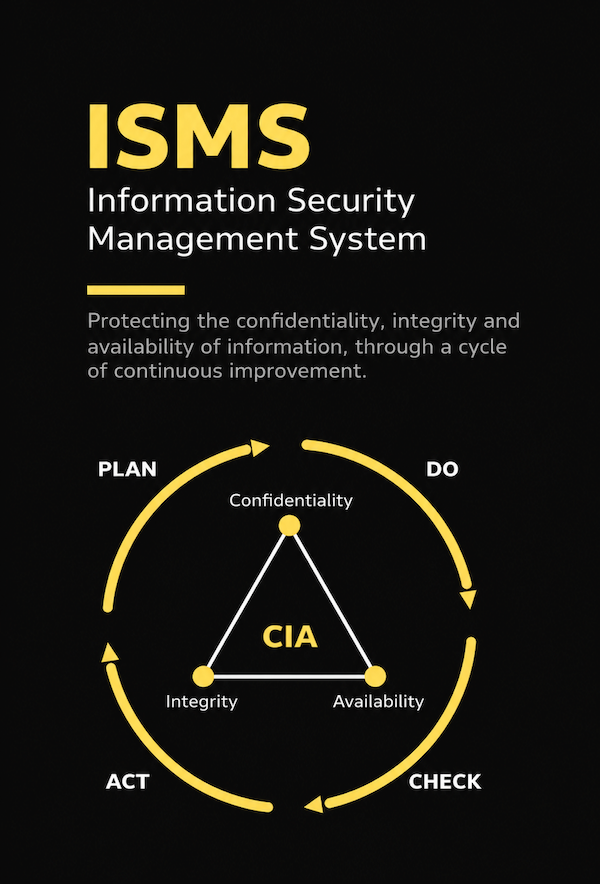
An ISMS primarily aims to protect three properties of information, commonly referred to as the “CIA triad”.
Confidentiality ensures that only authorised people can access information. It relies in particular on access rights management, encryption and strong authentication.
Integrity ensures that information remains accurate and complete and is not modified without authorisation. Logging, version control and backups all contribute to this.
Availability means that information and systems remain accessible when needed. It relies on redundancy, recoverable backups and a tested recovery plan.
These three objectives can sometimes conflict. Very restricted access strengthens confidentiality, but it can also hinder availability. This is precisely where the ISMS plays a role: balancing these choices according to the organisation’s actual risks.
Why implement an ISMS?
To make risk-based decisions
An ISMS always starts with a risk assessment. This makes it possible to identify critical information and the threats facing it, then determine which measures should be prioritised. The security budget can therefore be invested where it provides the greatest protection.
To comply with the Swiss Federal Act on Data Protection (FADP) and meet your partners’ requirements
Since September 2023, Article 8 of the revised Federal Act on Data Protection requires controllers and processors to ensure a level of security appropriate to the risk through technical and organisational measures. An ISMS helps demonstrate that this obligation is being taken seriously.
Requirements are also becoming stricter for critical infrastructures. Since 1 April 2025, the Federal Information Security Act (ISA) has required operators of critical infrastructures to report any cyberattack to the FOCS within 24 hours. Their suppliers, often SMEs, therefore increasingly need to demonstrate that they have their own security under control.
To withstand an incident
During the first half of 2026, the FOCS recorded 79 ransomware attacks, and the actual number is likely higher, since not all victims report them. Faced with this type of attack, an organisation with an ISMS does not have to start from scratch. Everyone’s roles are already defined, as are the data that need to be restored first and how communications should be handled. This enables the organisation to resume operations more quickly and limit its losses.
To build a security culture
Technology cannot compensate for an employee who is not properly informed. An ISMS integrates training and awareness into normal operations, for example through regular phishing simulations. Security becomes a shared reflex rather than something that belongs solely to the IT department.
What does an ISMS consist of?
An effective ISMS relies on several elements working together. It all starts with an information security policy approved by management. This policy defines the scope and objectives and clarifies everyone’s role.
The next step is to assess the risks and then treat them. This leads to an action plan and a Statement of Applicability, a document specifying which controls from Annex A have been selected or excluded, together with the justification for each decision.
These measures are of two types. Some are technical, such as access control, encryption or network monitoring. Others are organisational, such as supplier management, employee onboarding and offboarding, and information classification.
Monitoring is an often-overlooked element. An ISMS only remains effective if it is regularly reviewed through indicators tracked over time, internal audits and penetration tests, as well as management reviews. Incident management also contributes, because every incident reveals an area that can be improved. Without this monitoring, documentation quickly becomes outdated and no longer reflects reality.
How do you implement an ISMS step by step?
Implementation generally follows the PDCA cycle. Each cycle provides an opportunity to improve the system.
Source: Data Guardians, based on the ISO/IEC 27001:2022 standard (International Organization for Standardization)
| Step | What the organisation does |
|---|---|
| Plan | Define the scope, inventory assets, assess risks and set objectives. |
| Do | Implement the selected measures, train teams and document procedures. |
| Check | Measure effectiveness, conduct internal audits and analyse incidents. |
| Act | Correct gaps and adapt the ISMS to new threats or changes in the business. |
For more detail on each phase and how to keep the system operating over time, see our guide ISO 27001: Successfully Implementing, Maintaining, and Continuously Improving Your ISMS Over Time.
What obstacles hold SMEs back, and how can they overcome them?
Lack of resources is often the first obstacle. Few SMEs have a full-time security manager. Many therefore choose to outsource this role to an ISMS Manager or external CISO, present for a few days a month, rather than hiring internally.
Document management is another challenge. Between policies, the risk register and audit evidence, documents multiply and often end up scattered across spreadsheets. A governance platform such as DGRC makes it possible to centralise everything and monitor the progress of security measures. We compare the two approaches in this article.
The human factor also plays an important role. Procedures decided without consultation often create resistance. Involving teams from the risk assessment stage and explaining the purpose behind each rule significantly improves their buy-in.
Finally, the threat landscape never stops evolving. An ISMS that is never updated can become obsolete within a few months. The regular reviews provided for by the PDCA cycle are therefore essential: they are what keep the system effective over time.
Is certification required for an ISMS?
Nothing requires an organisation to have its ISMS certified. ISO 27001 certification nevertheless remains an important asset, as it demonstrates the seriousness of the organisation’s approach to clients and customers, who are increasingly requesting it. Data Guardians itself obtained this certification in October 2026.
This trend can be seen worldwide. According to the ISO Survey, there were 125,622 valid ISO/IEC 27001 certificates at the end of 2025, compared with 96,709 one year earlier. Once obtained, the certificate is valid for three years, subject to an annual surveillance audit.
For a small organisation, the Swiss Cyber-Safe label is an interesting alternative, with significantly less documentation. We explain the differences between the two approaches in our article Cyber-Safe Label and ISO 27001 certification: do you have to choose?.
Conclusion: where should you start with your ISMS?
With an ISMS, information security becomes a managed process that is continuously measured and improved. Your data are better protected, whether in terms of confidentiality, integrity or availability. You are also better prepared to meet the requirements of the FADP and the expectations of your partners.
The process starts with a gap analysis, which compares your current practices with the requirements you are aiming to meet. This makes it possible to define priorities and estimate the budget required.
Would you like to know where your organisation currently stands? Data Guardians operates throughout French-speaking Switzerland. Contact us for an initial, no-obligation discussion.